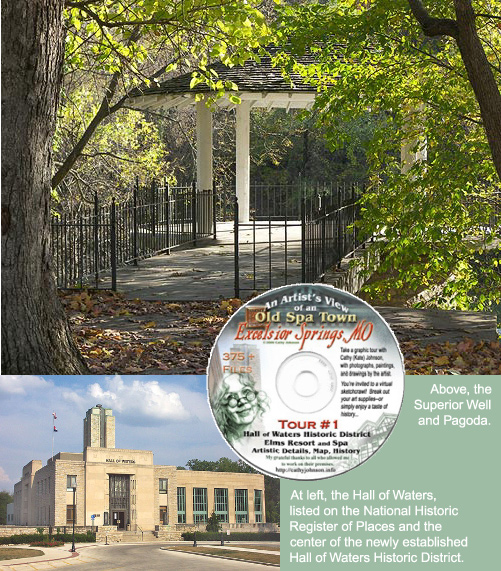
In a secluded Missouri valley with a river running through it, a spring was discovered to have healing qualities. A black settler by the name of Travis Mellion had a daughter afflicted by a severe skin condition. He had tried many remedies prescribed by doctors, but nothing seemed to help the girls condition. The spring water had a discoloration, causing many settlers to shun it, however, Mellion took some to his house and gave it to his daughter to drink. Some of the water was also heated and used for bathing. Within a few weeks, the skin ailment was completely cured.
A German farmer, Frederick Kugler looked at the spring with interest and began to treat his rheumatic knees and a running sore on his leg caused by an old Civil War gunshot wound. Again recovery occured and word spread of the two incidents.
The year was 1880. The land upon which the spring gushed forth into the Fishing River belonged to Anthony and Elizabeth Wyman. It was 40 acres, planted in wheat. A Missouri City minister by the name of J.V.B. Flack heard of the cures and he advised the Wymans to have the land platted, the water analyzed and to advertise the waters. The idea was agreed upon. Dr. Flack built a home on the 40-acre tract, opened the first dry goods store, founded the first church, the Christian Union, and preached from its pulpit.
From Longfellow's much quoted poem, he named the spring "Excelsior," later changed to Siloam Spring. Before a year had elapsed, 200 houses nestled in the little valley, while hundreds of visitors had to content themselves at camp fires, under the tents, and in the shelter of covered wagons, camped in hope that continued use of the waters would revive their health. Soon other springs and wells were discovered, pumps were installed, stores were opened, hotels were built and the city which was to become "America's Haven of Health" was born.
The rarity of having 20 separate mineral springs bubbling out four distinct varieties of water has given Excelsior Springs the rightful claim of having the world's greatest group of mineral waters. The particularly unusual feature of the distinguished group lies in the fact that it includes two of the six world's known iron-manganese springs. The waters were provided from the wells. Then in 1936, a ground-breaking took place for a magnificent structure that would house the "Hall of Springs," mineral water pool and men's and women's hydrotherapy departments. Today known as the Hall of Waters, the area of the building known as the Hall of Springs is called the water bar and still features the original and the world's longest water bar. Art Deco style architecture was chosen as in keeping with the Mayan Indian tradition relating to water and water gods.
|
|